In a recent
discussion on
Facebook, my friend Doug wrote:
recall that we were told that Katrina, the ten following years, would
produce multiple category 5 storms. In fact, storms of that size would
become the norm. Has anything even come close?
When I read this, I wanted to ask: "You were told this by whom, Doug?" And I imagined his answer: "Them. The so-called 'climate scientists'."
Oh,
THEM!
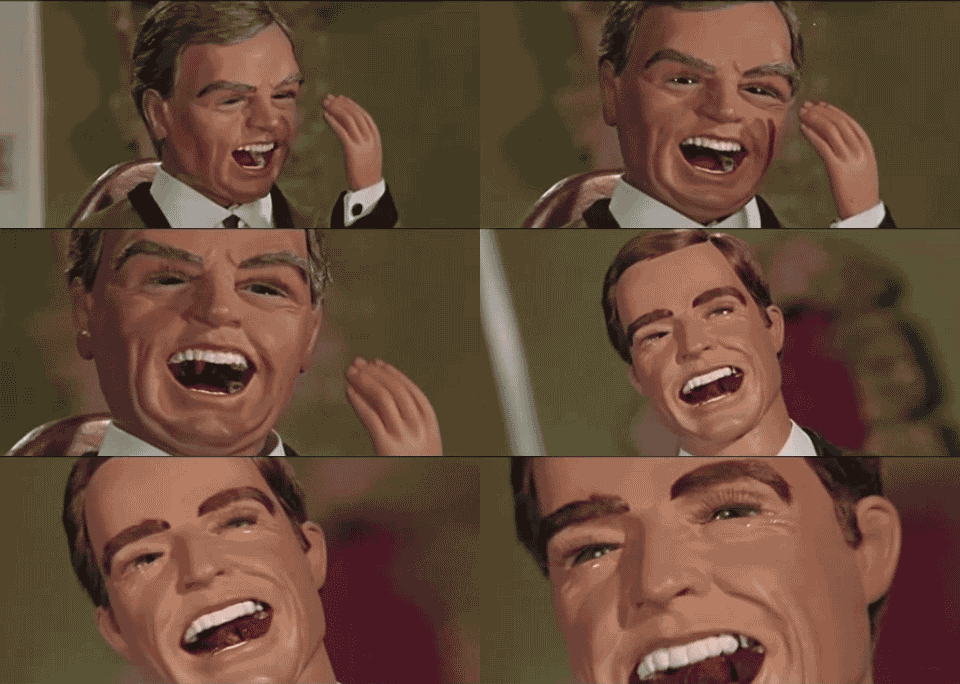
(Warning: gratuitous video next!)
The implication of a statement in the form "Recall when we were told..." or "Remember when
they told us...") is that
they are untrustworthy, because
they have said things-or predicted things--that haven't come to pass.
They have lied to us; misled us; caused us to have unrealistic expectations.
They were wrong before, so we can't trust anything
they say!
Indeed, what
they said was, not only unreliable, but
laughable!
You see this kind of statement all over the
Internet.
Let me give
some many examples.
In the following, click on the ? if you want to see the source of the example. The links that aren't in the ? are mine; follow them to learn more about the issue. Note that I've corrected some spelling and and added the word "that" in most of the following. If you wish, you can skip most of these examples.
Examples of:
"Remember when they told us...
...that you can dream high and you can reach it if you wanted to
?"
...that we would use nothing but
cursive in high school
?"
...in high school to go to college for
programming because the demand was so high
?"
...that you
couldn't subtract past zero
?" (This example is interesting; I actually think that teachers
often lie to their students as part of instruction.)
...that resumes should not be longer than
one page
?"
...that CEOs would be
blogging every day, and customers would be so enthralled with this level of authenticity that they would open their wallets in approval
?"
...that MIDI music downloads wouldn’t work on
Q-Link because of their size
?"
...that everything was already in place at the ports in preparedness for the
ebola virus
?" (This illustrates that often the writer of the "Remember when they told us...?" question is writing
from a particular time and place.)
that
everything was already in place at the ports in preparedness for the
ebola virus - See more at:
http://www.stlucianewsonline.com/st-lucia-is-prepared-to-deal-with-ebola-virus-senior-medical-officer/#sthash.i4nH7Fy1.dpuf
...that we were all gonna die from
swine flu?"
...that we didn't have
enough flu vaccine
?"
...that
HIV was not a serious threat
?"
...that diseases like
polio and
measles were 'eradicated'
?"
...there would be very very few of the rare
sunsthat had planets around them
?"
...that there were 9 then 8 then kinda 9 but really 8
planets in our solar system
?"
...that we couldn't
confront a burglar
?"
...that having the
Duke of Edinburgh Award on our CV would make us super employable
?"
...that this information [about personal income collected in the census] would be
used by the Federal government to determine how money will be apportioned in the future
?"
...when they told us right after
nine eleven that the
air was safe to breathe
?"
...that the Ground Zero Victory Mosque was not so much a
mosque as a 'community center'
?"
...that
underneath the [World Trade Center] buildings was molten liquid metal flowing like a
river...part of the reason it was impossible to find the black box
?"
...that there were
weapons of mass destruction in Iraq
?"
...that Iraq's
oil revenues would pay for this "liberation" and not American taxpayer money
?"
...that this combined
recession and period of recovery would last decade or more
?"
...that gas would
cost less [after the Iraq war]
?"
...that the army had been ambushed and a female,
Jessica Lynch, had been captured
?"
...that 87987235498673954 Iraqis were killed during the war while attempting to fix flat
tyres?"
...that Obama was
smart and Sarah Palin was
dumb?"
...that the Obama administration would
improve relations in the world after Bush screwed them up so bad
?"
...that Obama was make the world
love us
?"
...that that the world would l
ove and respect us again just as soon as Bush was gone
?"
...that if
TARP wasn’t passed, the country would fall into a recession
?"
...to pass the
bailout and everything will be fine, remember when they told us to pass the
debt ceiling and everything will be fine
?"
...that the old [health-care] plans were worse ['
sub-par']
?"
...how necessary it was that 'we provide the 40-45 million uninsured' with a
health policy and that it would
lower everybody’s health insurance cost
$2500 a year
?"
...that Obamacare would
improve selection
?"
...that only “the wealthy” would be paying more
out of pocket during The Big Barry Era of Enlightenment and Prosperity™
?"
...that Barry was gone lose to Mitt Romney after that lying ass
debate?"
...that we were doomed because Democrats were going to resurrect it [the
Fairness Doctrine] when they took power
?"
...that we should not expect to enlarge the nominal
bike lanes at the expense of car lanes
?"
...how bad composite implant materials were, or
adjustable loop fixation, or all suture anchors
?"
...that
epoxy grout was the way to go for our bathroom and that we would never have to regrout if we went with epoxy grout
?"
...the world will
end in 6/6/2006
?"
...the the world was going to
end on December 21, 2012
?"
...that autism was because of emotionally cold and lazy
mothers?"
...that
cholesterol was bad - killer bad
?"
...that margarine was
better for us than butter
?"
...that
saccharine caused cancer and it was banned
?"
...that butter, red meat, saturated fats, eggs and salt would
kill us
?"
...that coffee was
bad?"
...that that
CDs wouldn’t scratch
?"
...when they told us not to sit near the
TV?"
...in the early 90's that all these kids playing with video games were
going to be doctors and doing surgery with this technology
?"
...that 'low energy'
light bulbs would mean lower Electric Bills
?"
...that
computers would make our life easier, our work weeks shorter, utopia
?" and
here
...that the Internet would expand
freedom?"
...
that the future was in the cloud?"
...that that
online learning would make education available cheaply to everyone
?"
...when they told us to put the computer in the family room so you can
monitor your child's Internet usage
?"
...that the new 2400 baud
modems were as fast as they would ever get on copper phone lines
?"
...that
...that 'flat'
panels were revolutionary
?"
...that plant
automation would make everyone's life easier; more free time, better quality of live, etc.
?"
...that our interest rates were going to go down when the Fed last lowered the
prime?"
ag would never come back?”
...that ag[riculture] would never come
back?”
...that we would not have enough
oxygen because of logging in the amazon
?"
...that social security numbers would never be
used for purposes of personal identification
?"
...that they want to 'save social security' and were
determined not to siphon off
trust fund surpluses
?"
that
social security numbers would never be used for purposes of personal
identification? - See more at:
http://marginalrevolution.com/marginalrevolution/2004/09/should_we_priva.html#sthash.K4YRrAvB.dpuf
...that if
Barbie was real she’d just topple over because her proportions are so out of whack
?"
...if
Proposition 13 passed they would have to shut down the police departments, and schools, and fire stations etc. etc
?"
...what a good thing
NAFTA was supposed to be and how it would keep the illegals in Mexico
?"
...that Beyonce is
pregnant with another child
?"
...that
fracking (or
here) would decrease our dependence on foreign energy
?"
...that 'other women will be
drawn to the church as they see how happy and different the mormon women are'
?"
...that we would lose a million
jobs rather than gain a million jobs
?"
...that coconut milk products were bad? And avocados?"
coconut milk/ products were bad? And avocados?
...that thalidomide is as safe as milk for pregnant women?"
...that we had to
switch (or
here) from paper bags to plastic to 'save the trees'
?"
...that Compact Fluorescent Lites (
CFLs) would last longer but don't
?"
...that the future would be
ours?"
...that we were about to be overrun by emerging
cicadas?"
...that kids wouldn’t know even what snow was?" (This is a notorious example of "Remember when they told us...?" It is used by many climate bloggers skeptics deniers!)
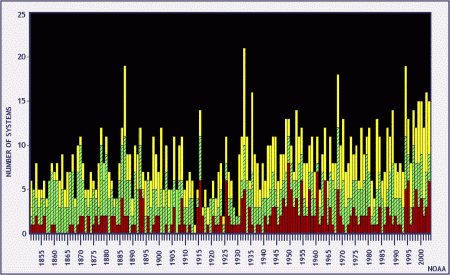
...that 2006 would be the worst hurricane season ever
?"
(Um, it
is getting gradually worse when you combine natural variations and
anthropogenic effects.)
...that it [hurricane activity] would only get
worse?"
(Um, it is.)
(Um, it does.)
And, my absolute favorite:
...that the moon was made of cheese
?
Who "told us" that the moon is made of cheese? Who are they?
When writers ask the "remember when they told us...?" question, they typically are making an explicit argument about what is true. But these arguments are also about power, because
who gets to define what's true is pretty much equivalent to
who has the power.
The power argument is often
implicit. That is, the reference to
who has the power is often
oblique.
(This is an example of why we need to teach our kids how to think critically: to examine conscientiously why certain people have certain beliefs.)
What happens when people aren't conscious of what they believe?
Look at what "Guest DERR UFO"
wrote:
Remember when they told us 4 or 5 years ago the web was gonna run outta
space? haha wow...never trust predictions by experts.Trust me.
Why should we trust DERR UFO?
Derr is saying that he's more reliable than "experts."What an amazing thing to say: "Never trust predictions by experts. Trust me."
Maybe
he never told us anything that is not true. Maybe
he never predicted something that might become true.
Or maybe he's just
frontin'.
What does the person who asks "Remember when they told us...?" mean by asking this question?
Often, the answer to the question is left hanging, as if the implication is obvious. (This is what Doug did in the Facebook conversation referred to above. My father, with whom I've been debating
climate change for years, responded "Yes. Thanks Doug." My Dad
remembers when "they" told us there would be more category 5 storms.
I "remember" it, too.
But what's the implication of our remembrance?
Looking at the prior conversation, my Dad had written:
"Climatologists can’t even answer most questions we have about the weather we are having from year to year."
Doug's "remember when...?" was intended to validate my Dad's claim: it served as an example of climatologist's predictions being wrong. (
Of course, Doug and my Dad "remember" that category 5 storms were supposed to get more frequent, but they forget that most climatologists predict that this won't be visible in the trends until late in the 21st century.
Sometimes a writer tells us explicitly what they mean. Sam, for example is responding to Hector's claim about a miracle:
Remember when they told us that if you had enough faith, God would move the
mountain. So of course I went to the window, looked at the mountain and
said, “Move the mountain.” It’s still there.
Sam is indicating his skepticism about the miracle proclaimed by Hector by showing an example where Sam believes he was misled about his powers to move mountains.
Sometimes writers will admit that they don't actually remember when they said whatever they said:
"I mean, I don't specifically remember that declaration," as Anne wrote after she asked, "Remember when they told us paper was dead?" She goes on, "but I do remember e-cards being pushed on us for a while. And now stationary's getting an even bigger comeback."
This shows that often (maybe most of the time), the question is
rhetorical. It's not about a specific event of someone saying something, but about the beliefs shared by a particular set of people or set of claims. "
They"
seemed to believe this at that time,
This proves that "they" can't be trusted.
(Or, perhaps it's we who can't be trusted. Sometimes we see the "Remember when they told us...?" question is when the writer wants to show how our response to something "they" said back then was wrong, so we should be careful about our response now. This turns the tables on the implication: it's not the experts we shouldn't trust, but our reactions to the experts. An example is here, where the writer asks, "Remember when they told us that one day everyone would own a computer? Oh, how we laughed!" But let's leave this alternative aside for now and go back to the most common use of the question, where it is "they" whose reliability is questioned.)
The rhetorical nature of the question is central to understanding it. Functionally, it is an easy way to establish commonality. It connects the writer with the reader, as if to say
"You and me? We're on the same team because we both remember when they told us, and we both know that they didn't prove it over time."
We tend to believe people whose pronouncements and predictions prove accurate, and those who speak in compatibility with our own experience.
This does ignore the tremendous complexity of some predictions, such as those having to do with climate. If
some scientists predict more category 5 storms but
some other scientists think their long-term variability will continue to override the effect of global warming, what do we think "they" are telling us? This illustrates the centrality of the
selection of "they" and the fact that memory of predictions of any kind, especially
climate predictions, is tremendously selective.)
In many of the examples I've collected above, the expertise of experts (
them) is called into question.
Who are
they?
[more here]
Most often, it's the failures of the predictions that liberal, progressive, establishment, and often academic experts make.
Most of the people who ask "Remember when they told us...?" questions are establishing themselves as anti-establishment, or anti-liberal.
Consider
this archetypal example from the blogosphere.
The author,
Miguel is discussing a shooting that has occurred in Miami involving an "AK-type" assault rifle. The police chief and mayor have used the occasion to call for a renewal of the federal assault weapons ban, "which according to the zeal you hear them talk about will eliminate
crime, reduce male impotence, bring back the housing market and bring
Michael Jackson back to life." :-)
But Miguel disputes the effectiveness of an assault weapons ban. According to his research (which happens to come from the
Daily Mail), Britain is the most violent country in the world--
far more violent that the US. Miguel continues:
You folks remember how tough Brits got on private possession of firearms
and how the politicos went to the extreme of de facto criminalizing any
type of self defense ... and
promising all British Subjects a more peaceful and human living in the
kingdom. Apparently it did not happen and Great Britain has beaten
everybody in violent crime.
(A chart is given that shows Great Britain WAY at the top of the world not only in the
rate of violent crimes, but in the absolute number, too, even above the USA. Of course, Miguel ignores the
fact that the definition of violent crime in the UK and in the USA is quite different, and the fact that the US rate of
firearm homicide rates is
WAY higher than most other countries in the world, including Great Britain. Guns do in fact
kill people.)
But that's not what I'm here to discuss. Miguel's next paragraph contains the rhetorical question:
Damn, it seems the problem was not the guns as the “intelligentsia”
was tired of telling us. Remember when they told us to watch “advanced”
countries like UK and adopt their ways so we could live a better life?
Well, it seems that not only socialized medicine failed but also the
concept of the Nanny State defending you against all evil if you gave up
the right and tools to defend yourself. By the looks of it, England’s
criminals are having a fair thanks to the government-sponsored
nationwide Gun Free Zone.
Miguel's "Remember when they told us....?" isn't linked to any specific claim (and I couldn't
find a specific instance of
them telling us that), but that's not the point. Miguel's target audience, like him,
know that the "intelligentsia" have thought that the US should emulate the UK and other "advanced" countries in gun control and other things (like "
socialized medicine").
(I'm sometimes amazed at how much the members of
like-minded groups know and
think the
same things as other members of those groups. For example: about
climate change.)
Let's summarize:
- The question "Remember when they told us....?" is used rhetorically.
- Invoking the question isn't so much an actually request for the reader to remember something but is a way of creating a sense of connection, or shared reality.
- "They" is intrinsically vague, not referring to any one person in particular, but a vaguely-defined group that isn't the writer and the reader.
- "They" is also typically some kind of establishment or "uppity" group that thinks it's better than the writer and the reader and therefore worth bringing down.
- The inherent complexity of prediction in a particular domain is ignored or at least downplayed.
- There's a kind of "guilt by association" at play here: if "they" lied to us in the past, "they" must be lying to us now.
- Use of the question (if it's not intended to remind the reader of his or her own gullibility) is typically intended to obfuscate what's actually true.
- Facts don't really matter.
- Generally, only people who are trying to argue a position unsupported by the facts uses this form.
The form of the question is really what follows:
Remember/imagine/imagine-that-you-remember/isn't it-easy-to-imagine-that-you-remember/you-can-probably-convince-yourself-that-you-remember
when
they/government-bureaucrats/politicians/experts/liberals/intelligentsia/climate-scientists/heretics/illegal-immigrants/poor-people/people-who-look-different-from-me/people-who-don't-speak-English/no-one-in-particular-but-anyone-you-could-imagine-being-so-foolish-as-to-believe-something
told-us/wrote/thought-that/might-have-thought-that/might-as-well-have-thought-that/probably-think--thr=at/probably-wrote-in-secret-emails-that-will-be-discovered-eventually
that X
was/is/will-be/might-be/has-a-small-probability-of-being/by-my-inscrutible-calculations-must-be/according-to-my-complex-multivariate-analysis-will-eventually-be
the case
but/however/in-my-mind-at-least/according-to-Rush-Limbaugh-or-Fox-News-or-some-random-Internet-site-probably-funded-by-fossil-fuel-companies
X
wasn't-true/isn't-true/won't-be-true/has-a-smaller-probability-of-being-true-than-they-said-it-does/is-inconvenient/doesn't-fit-within-my-overall-ideology/couldn't-possibly-be-true-because-it's-not-in-the-Bible/couldn't-possibly-be-true-because-it's-not-in-my-reading-of-the-Bible/couldn't-possibly-be-true-because-I've-never-seen-one-species-morph-into-another/isn't-possible-because-God-wouldn't-allow-it;
therefore
they/government-bureaucrats/politicians/experts/liberals/intelligentsia/climate-scientist/heretics/illegal-immigrants/poor-people/people-who-look-different-from-me/people-who-don't-speak-English/people-who-speak-English-but-I-don't-understand-what-they're-saying/people-who-think-they-are-better-than-m/people-in-a-different-echo-chamber
were-wrong/are-sometimes-wrong/will-always-be-wrong/can't-always-be-trusted/can't-ever-be-trusted/are-boneheaded/are-in-a-vast-conspiracy-to-get-grants-from-the-world-government/are-out-to-take-away-our-freedoms/can-serve-as-perfect-counterindicators-of-what-is-really-true/should-all-move-to-Europe-or-some-other-socialist-country
and
you/my-target-audience/everyone/true-believers
should/will/will-eventually/should-eventually/would-if-they-had-half-a-brain/better-if-they-want-to-go-to-heaven
trust
me/you/us/non-experts/non-intelligentsia/non-liberals/people-outside-the-Beltway/people-without-advanced-degrees/non-liberals/people-who-know-that-what-is-true-isn't-a-matter-of-science/true-believers/true-patriots/real-humans/God's-children/Jenny-McCarthy/Pat-Robertson/Jesus-as-you-know-him-in-your-heart.
I don't specifically remember that declaration
paper was dead?